
Renville County Criminal Docket Searches
Renville criminal cases sit in District Court. The remote entry point is Minnesota Court Records Online, or MCRO. Accept its acknowledgement first. Then pick Name, Case Number, Citation Number, or Attorney. Tighten things by choosing Criminal under Case Category and Renville under Court Locations. A statewide sweep works too, when you are unsure which county handled the matter. Each result row gives the case number, title, filing date, location, type, and status. Opening Case Details shows the Register of Actions, which is the court's running chronology of the case.
A full case number is the surest route in. Name searches demand a last and first name, and exact spelling gets you started. After two characters you can add a trailing wildcard. Sounds Like is a separate option. MCRO takes case numbers with or without dashes or leading zeros. It rejects spaces. Trust the fields on the screen rather than a similarly named stranger.
- Open MCRO Case Search and select the appropriate search tab.
- Choose Criminal and limit Court Locations to Renville when the county is known.
- Enter the complete court file number, or use the person-name fields with a careful spelling check.
- Open Case Details and read the Register of Actions, charges, hearings, and later entries in context.
- Use Court Administration for a certified copy, an older file, or a public record that is not available remotely.
The official MCRO Case Search is where a Renville criminal docket lookup begins.
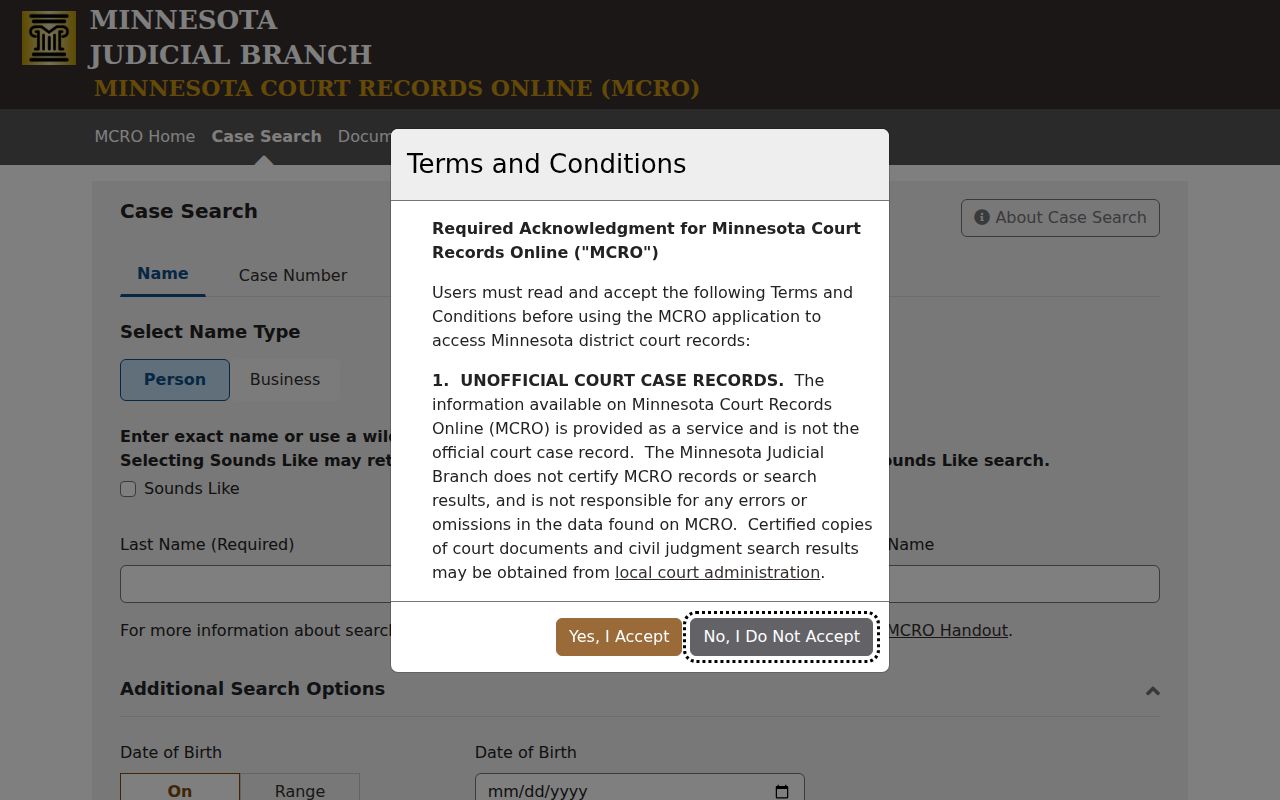
Its results open into Case Details. There the public Register of Actions can be read, though the display itself is not a certified record.
Renville County Criminal Case Numbers
The Renville weekly calendar shows numbers like 65-CR-26-178. The pattern pairs a local county identifier with case-category letters, a year, and a sequence number. Here CR marks a criminal case. Treat the code as a search aid. It cannot replace the Case Information panel or the case title. Nothing about charge or outcome can be read from it. Type the whole number into MCRO instead of guessing. Case Details is the fuller record view, with Case Events listed newest first. A Document Index Number can identify an event. Yet it promises no image. When a filing truly matters, run Document Search with the complete case number, then ask Court Administration for a public copy if nothing appears online.
- Register of Actions
- The chronological index of filings, notices, hearings, orders, and other court activity.
- Case Details
- The MCRO screen that groups case information, parties, events, hearings, and other available panels.
- Disposition
- The recorded resolution of a charge or case stage, which should be read in the language shown by the court.
Criminal Dockets: What They Show
A Renville criminal Register of Actions can hold far more than a caption and a hearing date. Panels may cover Case Information, Party Information, Charges, Warrants, Interim Conditions, Case Events, Hearings, Dispositions, Bond or Bail Activity, Financial Information, and Judgment Details. What shows up depends on the case and the access rules. Remember the limits. A displayed charge is an allegation. A hearing entry marks a scheduled or completed procedural event. It is not proof of what happened there.
| Case Information | Number, title, type, date filed, venue, status, citation reference, and any displayed related-case or flag information. |
|---|---|
| Charges | Charge description and public charge history, including an amendment if the record displays one. Read the disposition separately. |
| Hearings and events | Event description, date, hearing type, judicial officer, location, and connection information when available. |
| Disposition and sentence | The recorded plea, disposition, and sentencing language rather than a conclusion drawn from the case category. |
| Financial activity | Public fines, fees, payments, credits, bond or bail activity, and judgment details where those panels are present. |
Renville County Criminal Charges and Dispositions
Three moments on a Renville criminal docket get mixed up easily. A charge is an accusation. A disposition is the court's resolution of a charge or stage. A conviction is a criminal adjudication recorded by the court. None of them equals the others. Even a closed label deserves context. The recorded disposition or order says more than the status line when the result matters. Read the surrounding events too. An entry might reflect a plea. It could be an amended charge, a dismissal, a sentencing event, or a later probation event. Use the calendar and the register together to piece together procedural history, and get a certified document whenever an official purpose demands one.
Criminal Case Stages on the Docket
Renville calendar labels include first appearance, arraignment, omnibus hearing, pre-trial, court trial, sentencing, review hearing, and probation violation hearing. Each one marks procedure. A first appearance is an early court event. An arraignment may address the charge and the plea. The omnibus hearing is a criminal pretrial event, while a probation violation hearing deals with alleged noncompliance after an earlier stage. No label is a final finding.
Docket flow: Filing › First Appearance › Arraignment › Omnibus or Pre-trial › Plea or Trial › Disposition › Sentencing
The official Minnesota Rule of Criminal Procedure 6 sets statewide citation and response rules that can shape early criminal docket events.
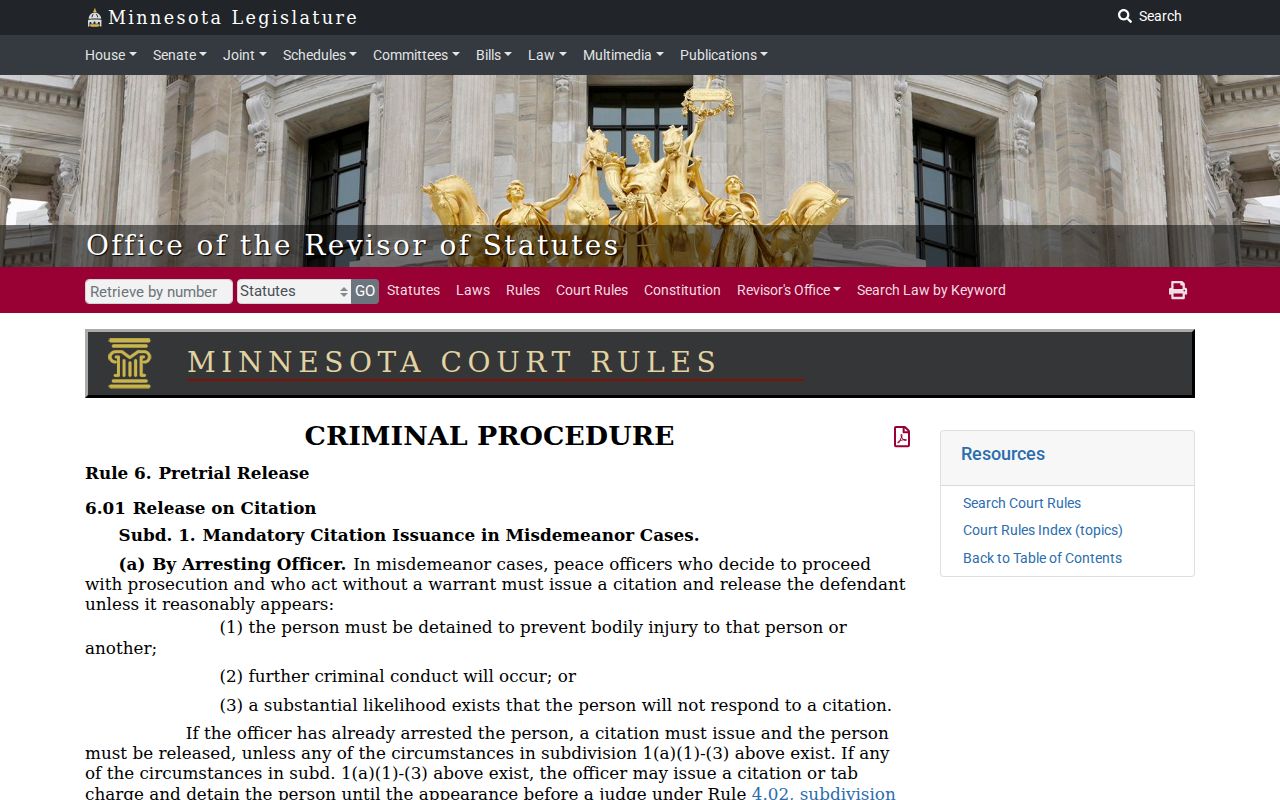
A calendar setting or a citation response date is only a date. Confirm any later action through the case register or Court Administration.
Renville County Criminal Warrant Entries
MCRO gives Warrants, Interim Conditions, and Bond or Bail Activity their own areas in Case Details. A public result may flag an active warrant. It may list an amount, show a posting history, or state release conditions. Each entry carries dates and case-specific context. Check that record date before repeating a warrant indicator as a current assertion. Confirm the matter with the court or the appropriate agency. Interim conditions shift as hearings modify them. Bond or bail information in the public register is likewise informational only. It is not a payment receipt. It does not say whether a person remains in custody or under any given condition.
Renville County Criminal Docket Courts
Minnesota runs one trial-court system. Criminal charges in Renville County land in the Renville County District Court. That court also handles civil, family, probate, juvenile, and traffic cases. The Eighth Judicial District is administrative only. It is not its own local trial venue. For a state-law criminal matter, use the Renville District Court record route. Skip the separate county criminal court database.
The public calendar can point you to a hearing date. Keep in mind it is not the full criminal docket. For anything case-specific, whether a public terminal search, an older file, or a certified copy, contact the local records office.
Renville County Court Administration
Renville County Courthouse
500 E. DePue Avenue
Olivia, MN 56277
320-523-3680
Monday through Friday, 8:00 a.m. to 4:30 p.m.
Renville County Criminal Docket Name Limits
A name-based search in MCRO has real gaps. The Case Search and Hearing Search can skip pending criminal matters entirely. Pending traffic and petty-misdemeanor cases without conviction may also fail to appear. So a name search that returns nothing does not mean no case exists. Nor should any public search read as a full personal history.
If the name comes up empty, try the complete court file number. The courthouse public-access terminal is the next step. It can display public information that remote tools withhold. Renville Court Administration handles current-setting questions and older records. The office also covers the Name Not Available Online result and requests for public copies.
Access Rules for Criminal Dockets
Minnesota Rule of Public Access 2 sets the baseline. It defines what judicial records the public can see. Rule 4 lists the restricted categories. Rule 8 then splits remote electronic access from what you can view at a courthouse terminal. MCRO is a useful public layer, not the whole court file. Every district courthouse, including Renville, has statewide public-access terminals. Renville Court Administration can explain how to view material or order a copy.
Confidential, sealed, and juvenile records play by different rules. Minnesota's expungement statute can also pull qualifying records from public view. Getting confidential or sealed material may require the Judicial Branch access-request process. It may also take a judge's decision. A case number alone guarantees nothing.
Key Rules:
Rule 2 sets Minnesota's general judicial-record access framework.
Rule 4 identifies records and categories with restricted access.
Rule 8 addresses differences between remote access and courthouse-terminal access.
Minnesota Statutes section 609A.03 provides the statutory expungement process for qualifying records.
The official Rule 4 public-access source lays out which judicial records get more limited treatment and why.
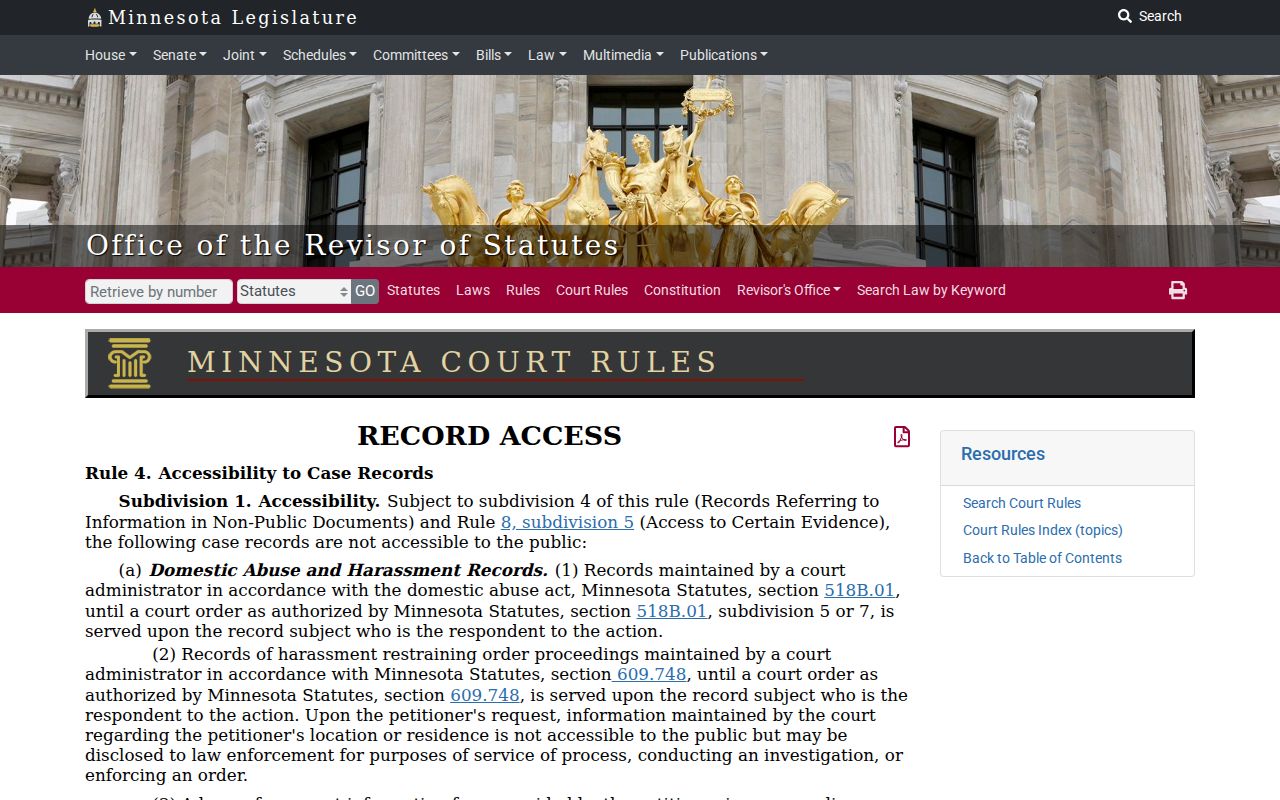
What you can reach remotely is often narrower than what a courthouse terminal shows. Neither channel can override a sealing order or a confidentiality rule.
Renville County Expunged Criminal Records
An expungement or sealing order changes what a Renville criminal docket search will show. A blank result can stem from the rules, a search limitation, a misspelled name, or an unavailable record. It can also stem from none of these. It is never proof that a person had no case. For case-specific access questions, work through the court record. Use the applicable Judicial Branch process instead of trying to reconstruct restricted information yourself.